RV Propane System & Safety Inspection
On-site leak testing, regulator swaps, line tracing, and safety checks. Local pros keep your furnace, fridge, stove, and water heater running safely.
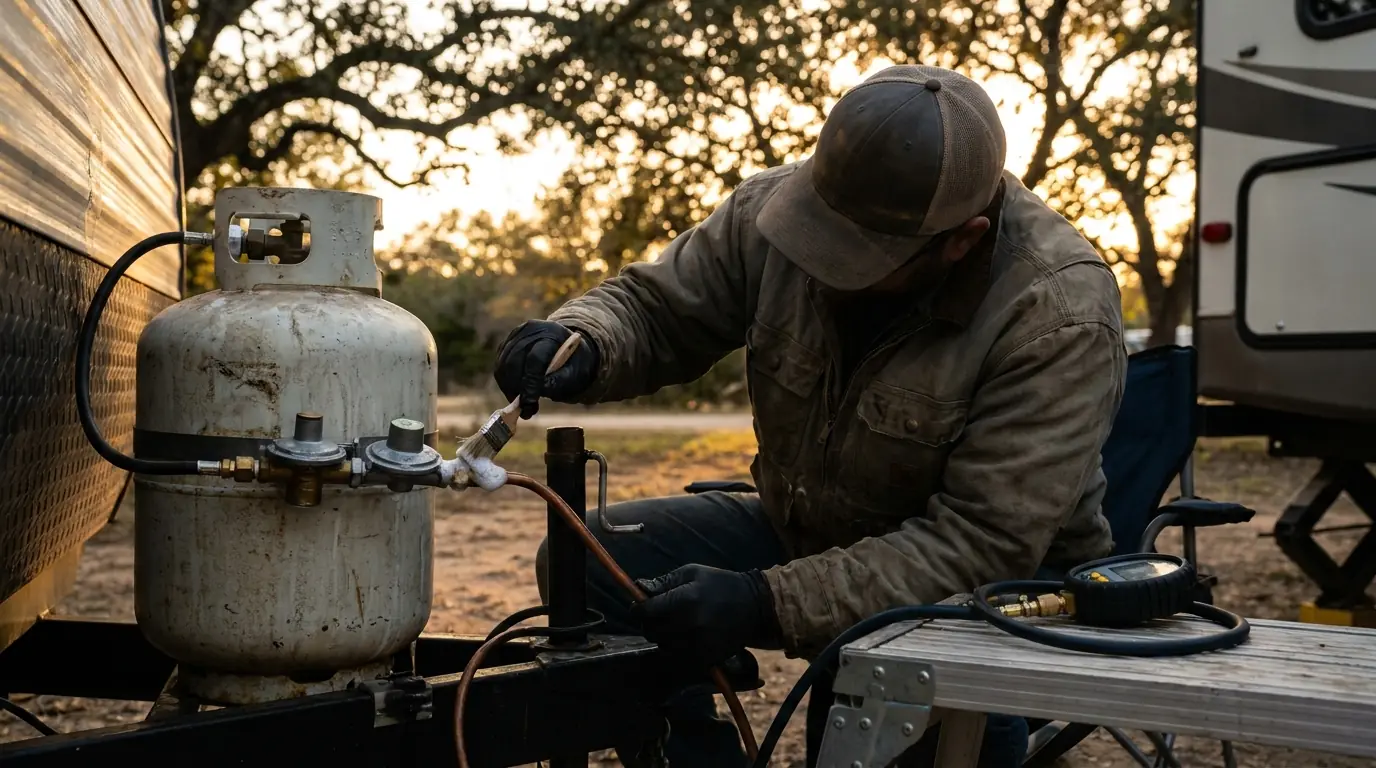
Propane is the one RV system where a small problem is a safety problem. So a local pro works by a set method, not a guess. The pro starts with a timed pressure test on the whole system using a manometer. If the system won't hold pressure, there is a leak. The pro traces it to the regulator, a pigtail, a fitting, or an appliance using leak spray and smell. An open flame is never used. Once the leak is fixed, the pro confirms the system holds. Then the pro checks that every appliance lights and runs on steady pressure.
The two-stage regulator is the heart of the system and a common weak spot. A regulator that is iced up, leaking, or set wrong causes yellow-tipped flames, a furnace that won't stay lit, and a fridge that won't cool on gas. A local pro sets the pressure to spec, replaces worn pigtails and old rubber hose, and checks the gas detector and its date. Rusted buried steel line, tank recertification, and lines built into cabinets are handled as planned or shop work when needed.
Sound familiar?
- You smell propane inside or around the rig
- Furnace, fridge, or water heater won't stay lit on gas
- Burner flames are yellow-tipped or lazy
- The regulator is icing up, hissing, or leaking
- The gas detector keeps going off
How the diagnosis works
- Run a timed pressure test on the whole system with a manometer
- Measure the pressure against the regulator spec
- Trace leaks with leak spray to the regulator, fittings, or hoses
- Check pigtails, rubber hose, and connections for age or damage
- Test the gas detector and check its date
How the repair typically goes
- Replace bad two-stage regulators and set the pressure
- Replace worn pigtails, hoses, and leaking fittings
- Fix or replace the leaking line and appliance connections
- Re-test the system to make sure it holds pressure
- Check that each appliance lights and runs on steady pressure
Good fit for mobile repair
- Pressure leak testing and pressure setting
- Regulator, pigtail, hose, and fitting replacement
- Appliance gas connection repair and detector testing
When a shop is the honest answer
- Tank recertification, requalification, or valve replacement
- Rusted buried steel line or line built into cabinets
Common components and causes
- Two-stage propane regulators
- Pigtails and rubber supply hoses
- Brass fittings and flare connections
- Gas leak detectors
- Appliance gas valves and jets
- Old, cracked, or dry-rotted hose and pigtails
- A worn or dirty two-stage regulator
- Loose or over-tight flare fittings
- Road shaking loosening appliance connections
- An expired or failed gas detector
Safety first
- If you smell propane, shut the tank valve and put out all flames and pilots. Do not touch any light or switch. Open up for air and leave the rig until it clears. Then call before you run any gas appliance.
- Propane work must end with a pressure test that passes. Never put a system back in use on a visual check alone.
What affects the price
Every visit starts with diagnosis and a written quote before repair work begins. These factors move the number:
- A test-only visit or a full leak trace and repair
- Regulator, hose and fitting, or appliance connection parts
- How many appliances and connections get checked
- How easy the tank, regulator, and line are to reach
How much does mobile RV Propane System & Safety Inspection cost?
Most mobile RV Propane System & Safety Inspection runs $150 to $550 for most leak repairs and regulator work. On-site labor typically runs $120–$175 per hour, with a service call of $95–$150, credited toward the repair. Simple fixes cost the least. The final price depends on parts, roof or slide access, and your rig make and model. These are rough ranges, not a quote. Every visit starts with an on-site check and a written quote before any work.
- Drop-pressure (timed) leak test
- $95–$175
- Two-stage regulator replacement
- $150–$350
- Pigtail, hose, or fitting replacement
- $120–$300
- Line tracing and repair
- $200–$550
- On-site labor rate
- $120–$175 per hour
- Service call / diagnostic
- $95–$150,credited toward the repair
Want a real number for your rig? Call (830) 402-5300 and tell us what it is doing. You get a written quote before any work begins.
Related services
- RV Water Heater Repair
Mobile service for RV water heaters. Local pros fix elements, thermostats, anode rods, gas valves, and ignition faults, and handle tankless units on-site.
- RV Appliance Repair
Mobile diagnosis and repair for RV refrigerators, microwaves, convection ovens, cooktops, and vent fans. This covers both absorption and 12V compressor fridges.
Frequently asked questions
I smell propane in my RV. What should I do before a pro arrives?
Treat it as an emergency. Turn the propane off at the tank valve. Put out all flames and pilots. Do not touch any electrical switches or the slide. Open the windows and vents. Get people and pets outside until the smell clears. Do not run the furnace, fridge, or stove. When a local pro arrives, the pro runs a timed pressure-drop test on the whole system. That confirms the leak and helps find it. The pro traces it to the regulator, a fitting, a pigtail, or an appliance and repairs it before turning the system back on.
How is mobile RV repair priced?
You pay a service-call fee that covers travel and diagnosis. Then you pay for parts and labor on the repair you approve. A local pro gives you the diagnosis and a clear quote before any repair work starts. A pro never works on an open-ended okay. A few things change the price. Those are the part type, how hard the access is, and the size of the repair. Each service page explains this.
How quickly can a local pro get to me?
It depends on a few things. Your spot in the service area matters. So does how busy local pros are and whether your problem is an emergency. A local pro books scheduled visits for a time window and puts emergency calls first by safety. When you call, we take your request and share a real ETA from the pro instead of a blanket promise. We also follow up with you if the schedule changes.

Need rv propane system & safety inspection?
Call for honest phone triage, or send a service request and dispatch will follow up with a realistic window.