RV Battery & Charging System Repair
On-site testing, replacement, and lithium upgrades for RV house batteries. Local pros also check the converter, charger, and any slow drain to find why your rig won't hold power.
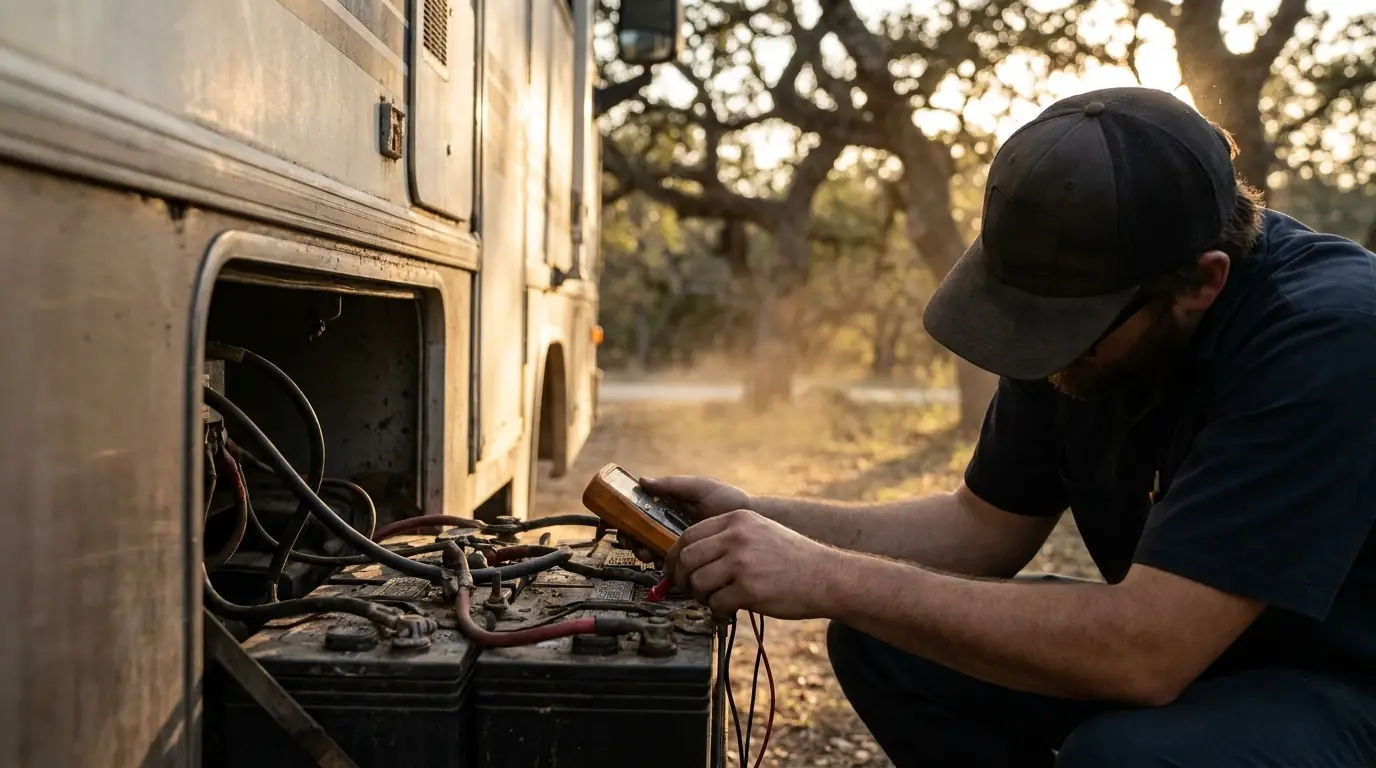
A dead or dying battery bank is the top reason an RV won't power up. And it is rarely as simple as old batteries. A local pro tests before selling you anything. Each battery gets a load test. The pro measures the converter and charger output and checks the shore-power, solar, and alternator charging paths. That shows if power is going in and staying in. Just as often the batteries are fine. The real cause is a tired converter, a corroded ground, or a slow drain quietly pulling the bank flat while the rig sits in storage.
When batteries are truly done, a local pro replaces them on-site. That means sulfated, swollen, or unable to hold a load. Local pros handle flooded and AGM deep-cycle types and full lithium (LiFePO4) upgrades with the right charge profile and, when needed, a DC-DC charger. Texas heat is hard on batteries. So the pro also checks the terminals, cables, and grounds that heat and vibration loosen. Large custom lithium and inverter builds or a rewired main harness are the exception. Those get scoped as bigger project work.
Sound familiar?
- Batteries go dead overnight or won't hold a charge
- The rig won't power up on battery, only on shore power
- Batteries read low even after driving or a full charge
- Lights dim or flicker and the pump runs weakly
- You want to upgrade from lead-acid to lithium
How the diagnosis works
- Load-test each battery against its rated capacity
- Measure the converter and charger output and charge voltage
- Check the shore-power, solar, and alternator charging paths
- Test for a slow drain with the rig sitting still
- Inspect the terminals, grounds, and battery cables for corrosion
How the repair typically goes
- Replace failed batteries or do a lithium (LiFePO4) upgrade
- Replace or repair a failed converter or charger and set its profile
- Repair corroded grounds, terminals, and undersized cables
- Find and fix slow drains pulling the bank down
- Check charge and hold under load before closing up
Good fit for mobile repair
- Battery load testing, replacement, and lithium upgrades
- Converter, charger, and DC-DC charger repair or replacement
- Slow-drain diagnosis and ground or cable repair
When a shop is the honest answer
- Large custom lithium and inverter builds beyond on-site work
- A damaged main wiring harness that needs a full rewire
Common components and causes
- Deep-cycle flooded, AGM, and lithium (LiFePO4) batteries
- Converter or charger and DC-DC chargers
- Battery cables, terminals, and lugs
- Battery isolators and lithium BMS
- Grounds and battery-bay bus bars
- Battery age and sulfation from sitting discharged
- Texas heat shortening battery life
- Slow drains draining the bank in storage
- A failed or underpowered converter or charger
- Corroded or loose terminals and grounds
Safety first
- RV batteries hold dangerous energy. A dropped wrench across the terminals can arc, burn, or split a battery. Lead-acid gas and lithium faults are both real hazards. So a local pro makes connections in the right order with the right protection.
What affects the price
Every visit starts with diagnosis and a written quote before repair work begins. These factors move the number:
- Battery type and count (lead-acid versus lithium)
- The size of a lithium upgrade (charger, DC-DC, BMS)
- Whether the converter or charger needs replacing
- How long it takes to trace a slow drain
How much does mobile RV Battery & Charging Repair cost?
Most mobile RV Battery & Charging Repair runs $150 to $700 for most testing, charging, and replacement work. On-site labor typically runs $120–$175 per hour, with a service call of $95–$150, credited toward the repair. Simple fixes cost the least. The final price depends on parts, roof or slide access, and your rig make and model. These are rough ranges, not a quote. Every visit starts with an on-site check and a written quote before any work.
- Battery & charging-system diagnostic
- $95–$200
- Deep-cycle battery replacement (per battery + install)
- $200–$450
- Lithium (LiFePO4) upgrade
- $600–$1,800+
- Converter/charger replacement
- $300–$650
- Parasitic-draw diagnosis
- $150–$350
- On-site labor rate
- $120–$175 per hour
- Service call / diagnostic
- $95–$150,credited toward the repair
Want a real number for your rig? Call (830) 402-5300 and tell us what it is doing. You get a written quote before any work begins.
Where this service is available
- RV Battery & Charging Repair in New Braunfels, TX
- RV Battery & Charging Repair in Canyon Lake, TX
- RV Battery & Charging Repair in San Marcos, TX
- RV Battery & Charging Repair in Seguin, TX
- RV Battery & Charging Repair in Cibolo, TX
- RV Battery & Charging Repair in Schertz, TX
- RV Battery & Charging Repair in Bulverde, TX
- RV Battery & Charging Repair in Garden Ridge, TX
- RV Battery & Charging Repair in Selma, TX
Related services
- RV Electrical Repair
Careful 12V and 120V fault tracing, converter and inverter repair, battery system service, and shore-power troubleshooting at your site.
- RV Solar Repair
Local pros test and fix RV solar systems, from panels and charge controllers to wiring and batteries. They also install right-sized upgrades at your site.
Frequently asked questions
Why do my RV batteries keep dying?
Both a bad battery and a bad charging system are common, so a local pro tests to find the real cause first. The pro load-tests each battery. The pro checks the converter and charger output. The shore power, solar, and alternator charging paths get checked too. The pro also looks for a hidden draw that drains the batteries while the RV is parked. If a battery is worn out or won't hold a load, the pro replaces it. That includes lithium (LiFePO4) upgrades. If the batteries are healthy, the fix is often a weak converter, a bad ground, or a hidden draw.
How is mobile RV repair priced?
You pay a service-call fee that covers travel and diagnosis. Then you pay for parts and labor on the repair you approve. A local pro gives you the diagnosis and a clear quote before any repair work starts. A pro never works on an open-ended okay. A few things change the price. Those are the part type, how hard the access is, and the size of the repair. Each service page explains this.
How quickly can a local pro get to me?
It depends on a few things. Your spot in the service area matters. So does how busy local pros are and whether your problem is an emergency. A local pro books scheduled visits for a time window and puts emergency calls first by safety. When you call, we take your request and share a real ETA from the pro instead of a blanket promise. We also follow up with you if the schedule changes.

Need rv battery & charging repair?
Call for honest phone triage, or send a service request and dispatch will follow up with a realistic window.